
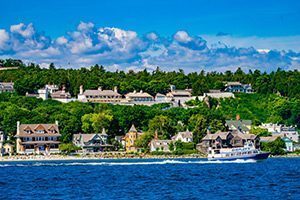
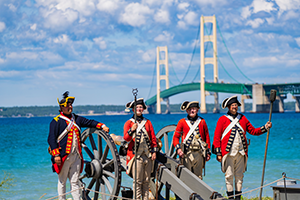



 Many visitors to the Straits of Mackinac know about the events of June 2, 1763, when a force of roughly 400 Ojibwa men captured the British fort of Michilimackinac in a skillfully executed surprise attack. What began as a seemingly innocent game of baggatiway held in honor of King George III’s birthday ended within minutes, leaving 15 soldiers dead and the fort’s commanding officer, Captain George Etherington, taken prisoner. The fall of Michilimackinac marked the low point of Etherington’s life. Nevertheless, this resourceful officer went on to build a long career in the British army, including service in the Caribbean during the American Revolution and, somewhat improbably, the loss of a second garrison to enemy forces.
Born in Delaware around 1733, Etherington entered the British army as an enlisted man before earning a commission in the 60th, or Royal American, Regiment in 1756. He served with the regiment throughout the Seven Years’ War and received promotion to captain in 1759. In 1761, the army ordered the 60th to garrison former French forts around the Great Lakes, and Etherington assumed command of Michilimackinac the following year. When the Ojibwa launched their attack in 1763, they caught Etherington and his garrison completely by surprise. Etherington and his subaltern, Lieutenant William Leslye, stood outside the fort watching the game and thus became among the first taken captive. The local Odawa later ransomed Etherington and the other survivors from the Ojibwa, and authorities shipped them to Montreal as prisoners later that summer.
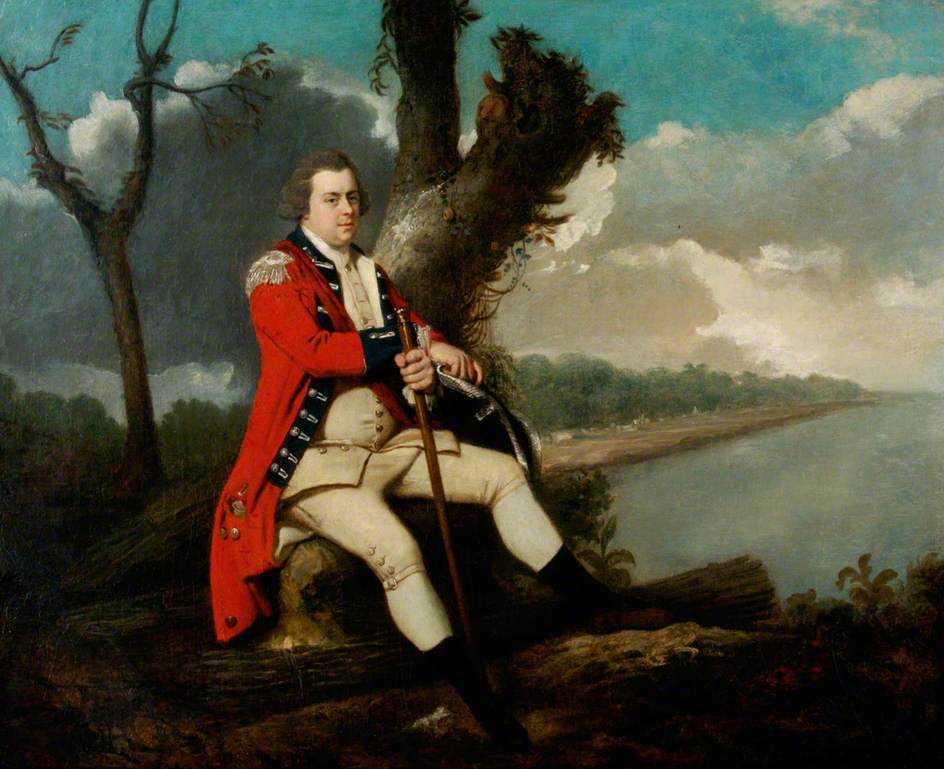
Despite losing his command, Etherington faced few consequences and continued to serve with the 60th Regiment, eventually earning promotion to major in 1770. He briefly commanded Fort Niagara in New York before joining his regiment in the Caribbean. While there, he played a key role in negotiating a peace treaty with the Indigenous Caribs of St. Vincent in 1773. Continued tensions with the Carib people, combined with the outbreak of the American Revolution, led authorities to place Etherington in command of the island’s military forces in 1777. By then a lieutenant colonel, Etherington received the appointment in part because of his reputation for maintaining good relations with the Caribs.
Etherington’s tenure on St. Vincent soon became mired in conflict with the island’s civil governor, Valentine Morris. These disputes came to a head in June 1779, when French forces arrived to attack the island. After allying with the American rebels in 1778, France launched offensive operations against British possessions worldwide, transforming the American Revolution into a global war. Over Morris’s objections, and with only a small force at his disposal, Etherington surrendered St. Vincent to the French without resistance. Unlike the loss of Michilimackinac, this surrender and Morris’s subsequent complaints triggered an official inquiry into Etherington’s conduct. A court martial, however, fully acquitted him of all charges. Etherington remained with the 60th Regiment and rose to become its colonel in 1782. He retired from the army in 1788, having maintained a solid reputation as an officer despite losing two commands to surprise attack.
Although his time at Michilimackinac proved brief, Etherington’s role in the events of 1763 permanently secured his place in the history of the Straits of Mackinac. Today, a street in Mackinaw City bears his name, and researchers continue to examine his career before and after the attack.
Further reading:
Colonial Cousins: Arent Depeyster, George Hamilton, and the Schuylers of New York