

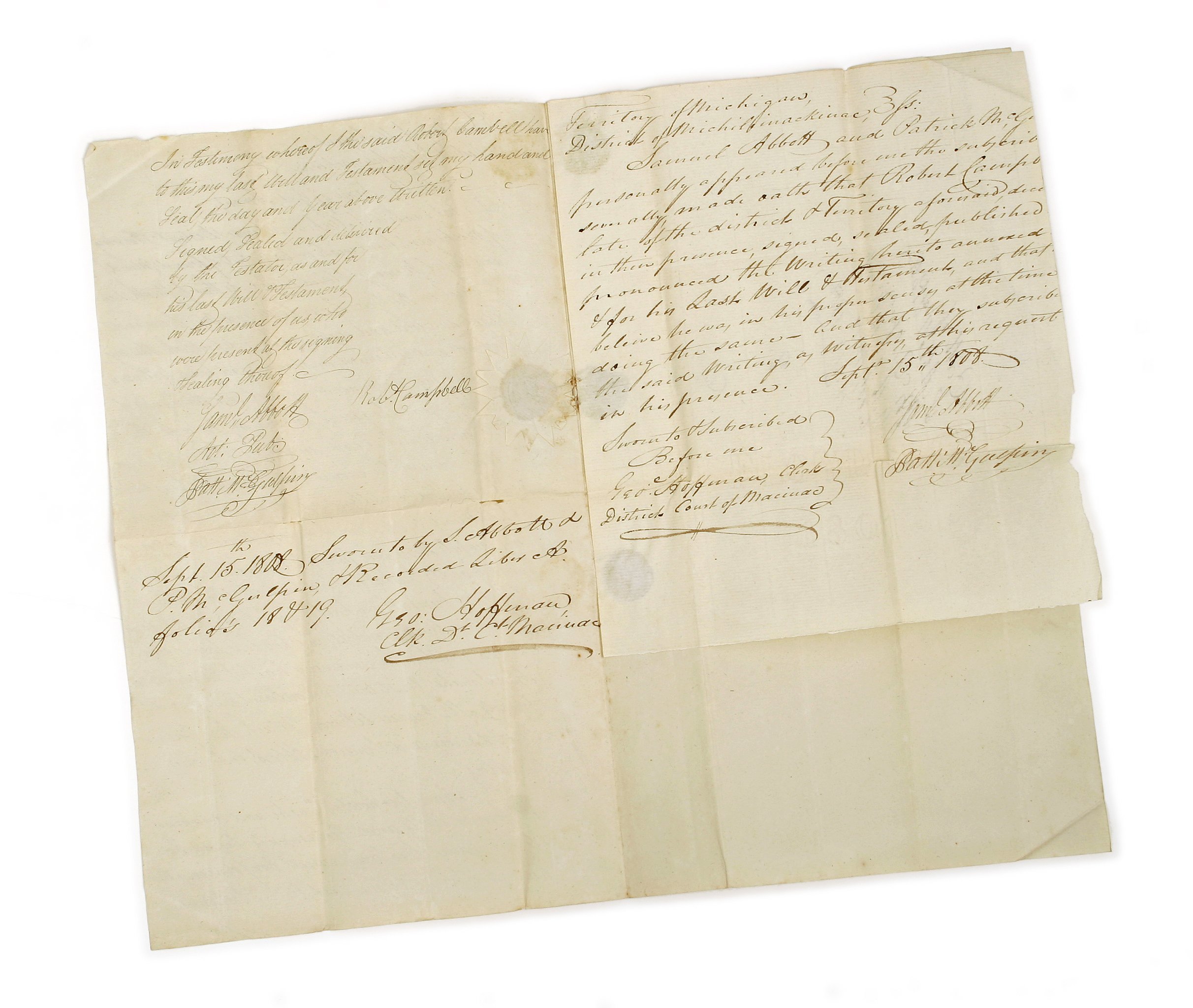
Archaeological work at Dousman’s Mill began in 1972, allowing historians, naturalists, and visitors to understand what life was like at the site of Michigan’s first water-powered saw mill. While archaeological discoveries like structural remains, military items, and mechanical parts help uncover what daily life may have been like, documentary evidence shows the importance of the saw mill as both a family business and a valuable part of the Michilmackinac community. One such document is the will of Robert Campbell, original owner of the mill.
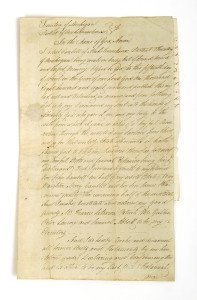 In the late 1700s, Robert Campbell recognized the need for lumber on both the mainland and Mackinac Island. The efficient mill he built on his 640-acre property was one of the Midwest’s first successful industrial endeavors, continuing operation from 1790 until 1839. Campbell was also a family man, raising a son and a daughter on the land that also housed the business. In 1808, Robert Campbell passed away, leaving the property and business to his children. His will states:
“This I give and bequeath to my beloved Son John Cambell [sic] One half of my whole Estate, to my Daughter Mary Cambell and her Son James Steavinson jointly the remaining half of the said Estate.”
Even though the will makes no specific mention of the division of land or ownership of the sawmill, what the document lacks in specifics it makes up for in context. Among the executors of the will were Patrick McGulpin and Samuel Abbott, two important members of the District of Michilimackinac. Abbott served as a justice of the peace, magistrate, notary public, and village president on Mackinac Island, while Patrick McGulpin was the father of William McGulpin, baker for the American Fur Company, pillar of St. Anne’s Church, and owner of the McGulpin house, now one of the oldest residential buildings in the state of Michigan. While the two witnesses may have been from different economic classes, Robert Campbell’s importance as supplier of lumber for the area would have put him in contact with many different kinds of people.
 Campbell’s son John owned the sawmill from 1808 to 1819, when the land was sold to Michael Dousman. For the next twenty years, Dousman continued to operate the mill as a profitable business, until the need for lumber declined, and the land was parceled off and sold for different purposes including limestone quarrying. In 1975, possession of the land was transferred to Mackinac State Historic Parks, where the land is once again home to a reconstructed working saw mill on the same space once owned and worked by Robert Campbell. Programs at the site include sawpit and sawmill demonstrations, naturalist programs, and guided nature walks.
Robert Campbell’s will is one of the only non-archaeological artifacts relating to Dousman’s Mill known to exist. At the time it was written, the document meant that the business would be left in capable hands and his children would have a continued source of income. Today, Robert Campbell’s will helps us understand his importance as a businessman, a father, and a member of the Michilimackinac community.