





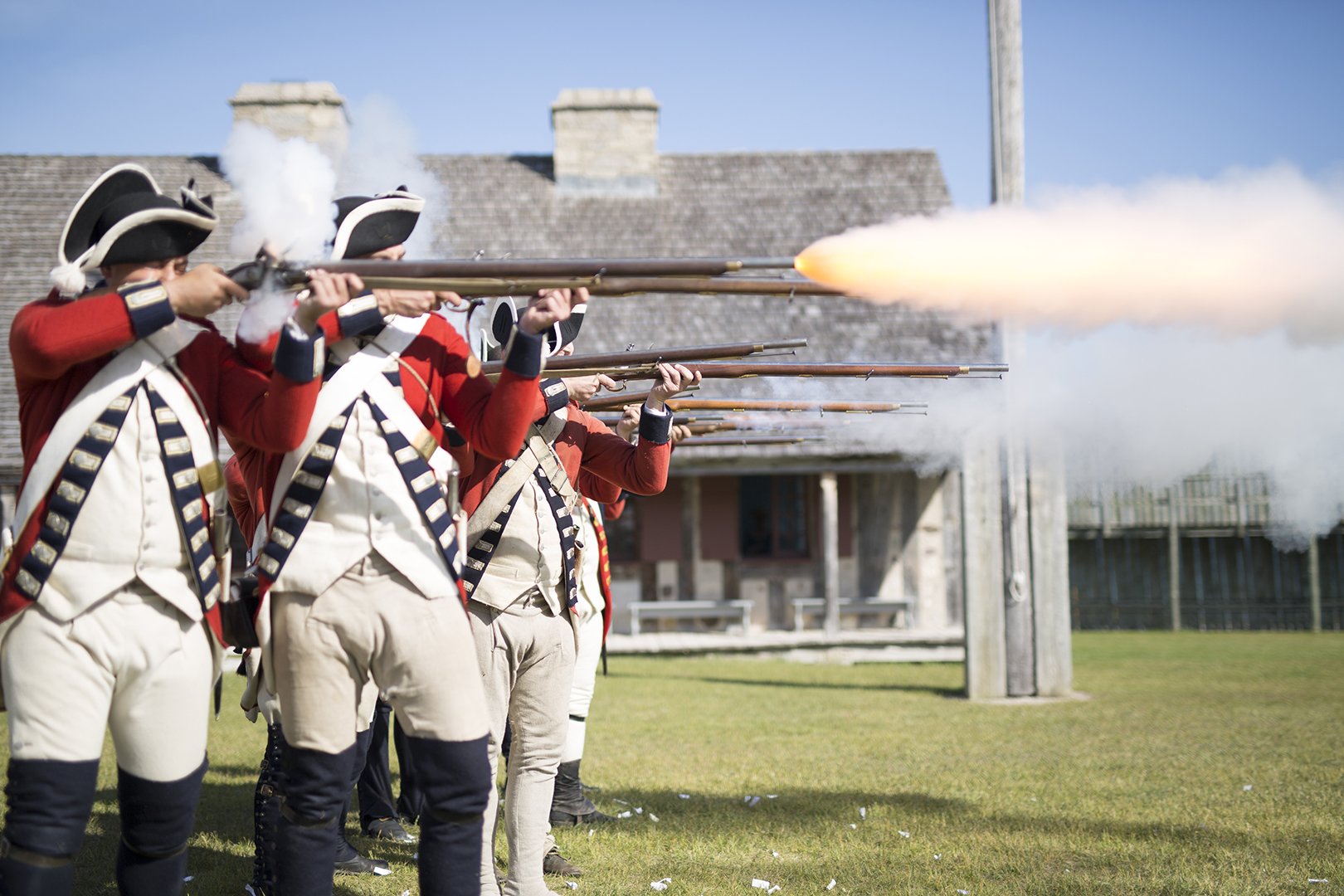
 When you visit Colonial Michilimackinac, you will likely encounter historical interpreters portraying British soldiers of the 8th Regiment. Each day, they fire their muskets in demonstrations that showcase the tactics used by the British Army during the American Revolution. Many visitors refer to these weapons as “Brown Besses,” but that label is overly generic and not entirely appropriate for the 18th century. A closer look at one of these arms reveals its proper name: the New Pattern Short Land Musket for Line Infantry.
Beginning in the 1720s, the British Army issued muskets built to standardized patterns. The Board of Ordnance contracted individual gunsmiths to produce components such as locks, barrels, and brass furniture, while Ordnance workers assembled the finished weapons at the Tower of London or Dublin Castle. The Board let contracts and produced arms on an as-needed basis, and its focus on economy led it to use existing stores before issuing newly manufactured components. As a result, soldiers often carried several versions of similar weapons at the same time. Even so, distinct musket patterns emerged over time, with specialized variants for line infantry, mounted dragoons, artillerymen, noncommissioned officers, militia, and sailors and marines. The Land series muskets armed infantry soldiers, with new patterns authorized in 1730, 1740, 1742, 1748, and 1756. Each successive model introduced improvements—such as the steel ramrod added in the 1748 pattern—yet all featured 46-inch-long barrels. Although officials experimented with shorter barrels, British muskets remained long throughout the century. In 1759, for example, Lt. Col. John LaFausille of the 8th Regiment supervised firing trials in England using muskets with 23-inch barrels. He reported that the shortened weapons matched the penetrating power of standard arms and proved easier for shorter men to handle. Despite these findings, the army retained long muskets, in part because their length, combined with a fixed bayonet, made them more effective at resisting enemy cavalry.
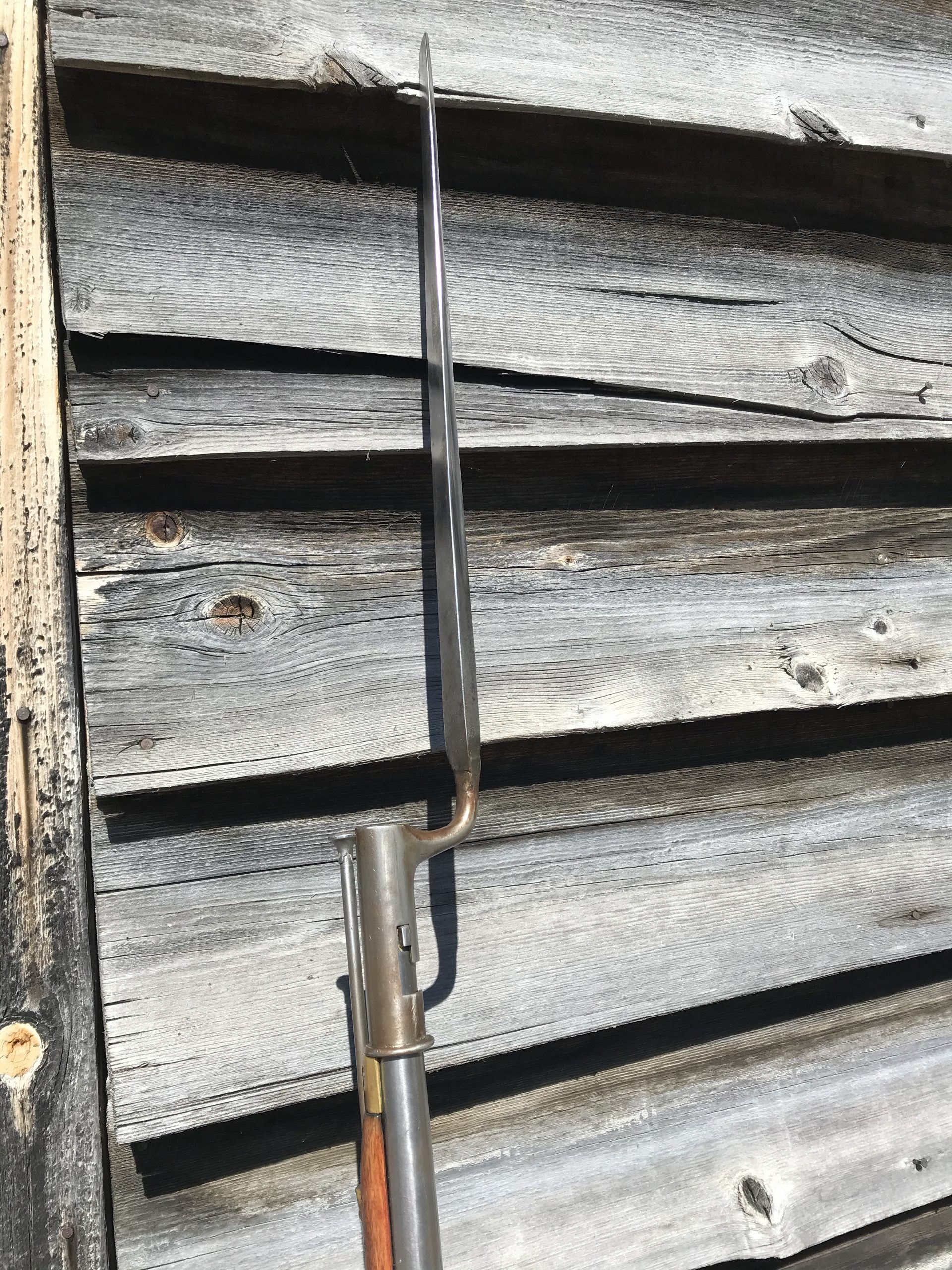
Although the Board of Ordnance rejected such drastically shortened weapons, experience during the Seven Years’ War—and the success of slightly shorter muskets issued to militia and naval forces—prompted officials to reconsider the standard infantry arm. After conducting tests in early 1768, the Board recommended a musket with a 42-inch barrel, which King George III formally approved in June. The Board soon issued contracts, and by the end of the year gunsmiths had delivered tens of thousands of components. The army placed the new muskets into service in 1769. Officials officially designated these weapons as the New Pattern Short Land Musket for Line Infantry, more commonly known as the Pattern 1769 or Short Land musket.
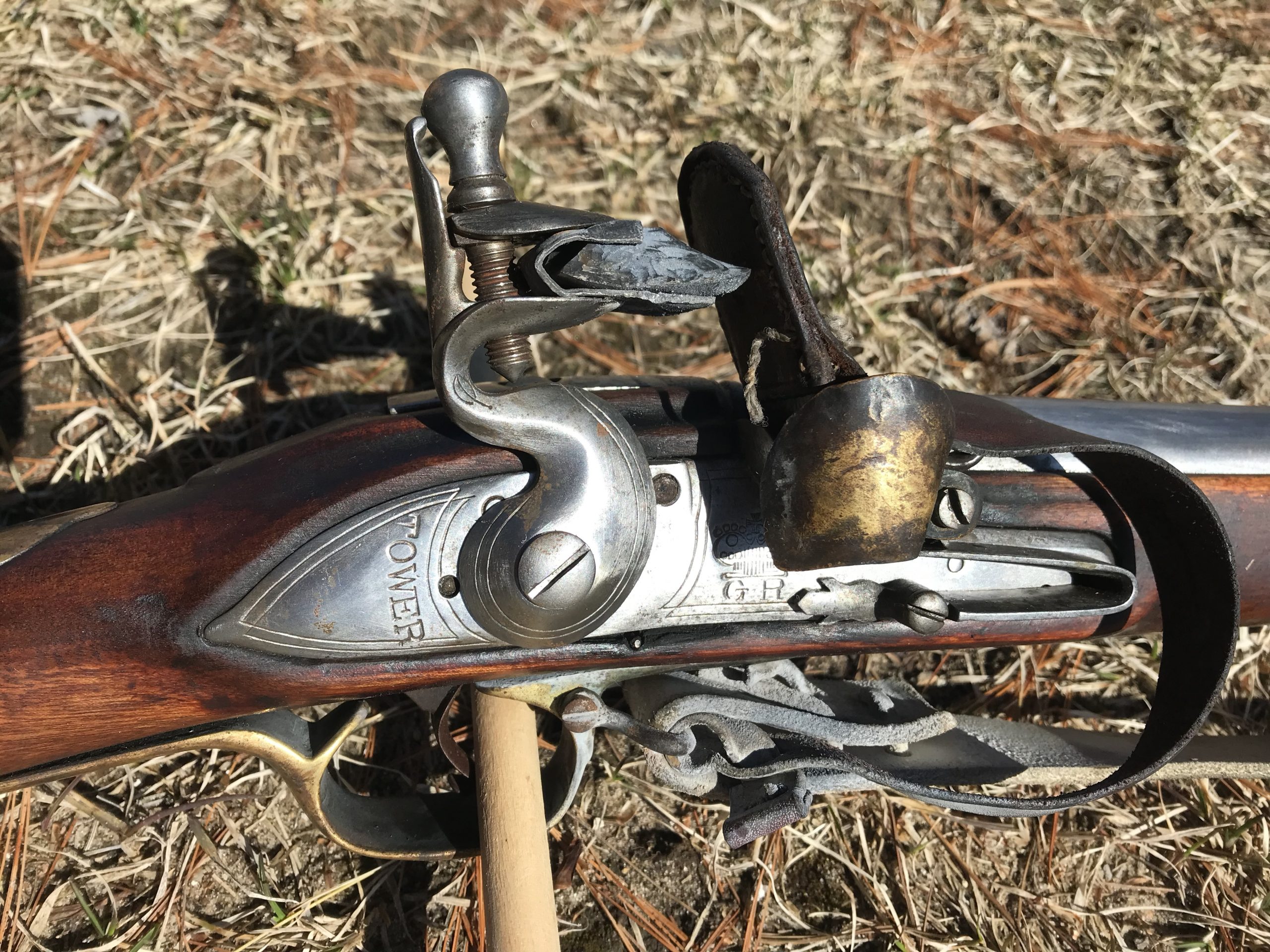
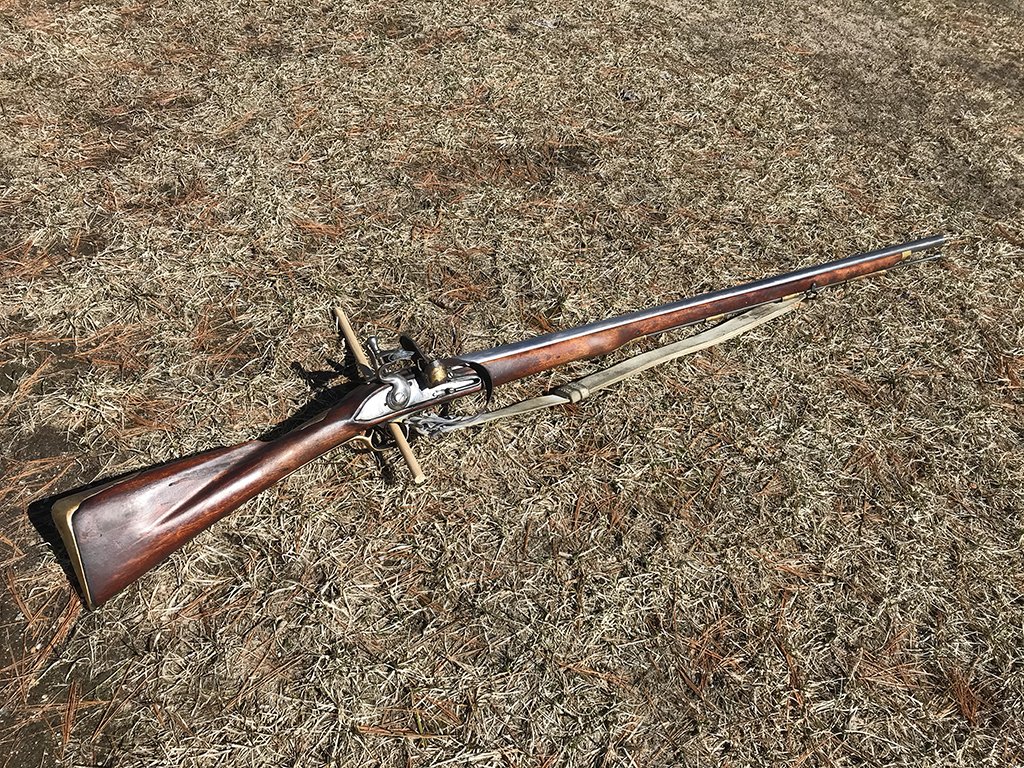
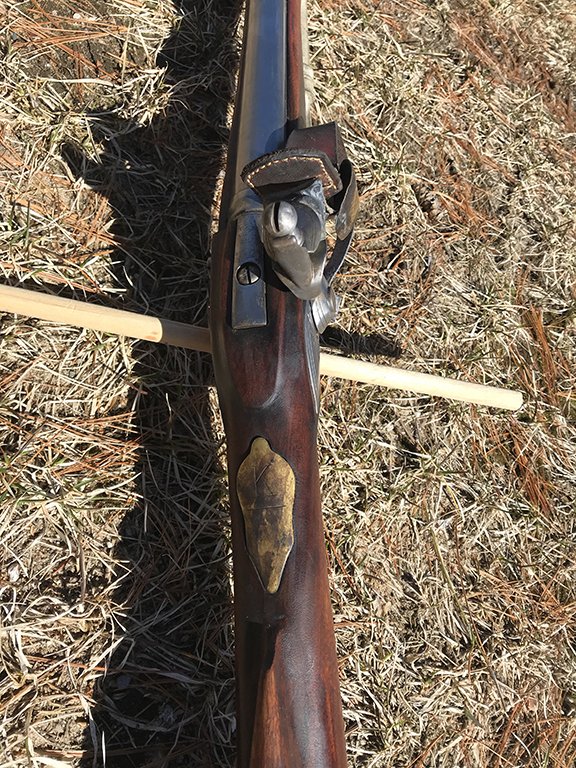
The musket shown here is a high-quality reproduction of a Pattern 1769 Short Land musket. It features a 42-inch, .75-caliber smoothbore barrel. The lockplate, similar to those used on the Pattern 1756 Long Land muskets, bears the engraving TOWER, indicating manufacture under the Ordnance system associated with the Tower of London. Earlier practices allowed individual gunsmiths to engrave their names on lockplates, but the Board abolished that custom in 1764. The engraved crown, GR, and broad arrow ahead of the cock all mark the weapon as government property. Regiments often added additional markings, usually engraved on the barrel, and assigned each musket a rack and company number to associate it with a specific soldier. Armorers typically engraved these numbers on the wrist plate. The cock’s comb displays relatively ornate decoration, and the hammer spring finial features a delicate trefoil design. The next model, the Pattern 1777 Short Land, simplified many of these decorative elements while retaining the overall appearance of the Pattern 1769.
It is important to note that although interpreters at Michilimackinac today carry and demonstrate reproductions of the 1769 and 1777 Short Land muskets, soldiers of the 8th Regiment historically most likely carried the Pattern 1756 Long Land musket. As noted above, the government’s preference for issuing older stocks before new models meant that the 1769 Short Lands did not immediately replace the 1756 Long Lands. The 8th Regiment received its last large-scale issue of new arms in 1766, when the 1756 pattern remained standard. The regiment did receive additional weapons in 1771, 1775, and 1778, but the first two issues replaced worn-out muskets, while the 1778 issue supported the regiment’s expansion through new recruiting companies in England. As a result, while some soldiers of the 8th may have carried Pattern 1769 Short Lands by the mid-1770s, most men likely continued to use the 1756 Long Lands—perhaps until their return to England in 1785. In fact, the Pattern 1756 Long Land remained the standard arm for grenadier companies, including the grenadiers of the 8th stationed at Michilimackinac, and for guards regiments until the late 1780s. The Short Land never fully replaced the older weapon.
Regardless of these historical nuances, the muskets carried and fired by interpreters today remain a central element of daily programming at Colonial Michilimackinac. Be sure to ask the interpreters about their weapons during your visit.
Dig deeper into the history of Colonial Michilimackinac: The Wall Gun, Weapons of Michilimackinac, The King’s 8th Still Present at Michilimackinac.